Even before I had a copy of any book by Siri Hustvedt, I was already keen on liking her prose mainly because Bennard said I would love her. Which, for all I know, is a contrived effort to make Hustvedt my new favorite author--Hustvedt that is wife to Paul Auster, one of Bennard's favorites. Well, planned or not, it appears that he is right. I loved Hustvedt instantly, the love-at-first-few-pages kind.
Aside from being my first novel by new favorite author, The Summer Without Men is also my first contemporary feminist book. And a memorable one at that. The characters are mainly women--Mia the Awesome Protagonist, the Swans in Rolling Meadows, the teen witches of Bonden, Lola the Neighbor-turned-Friend, Bea the Tough Sister, and Daisy the Lively Daughter. Even psychiatrist Dr. S. is a female! They were not portrayed as perfect, all-knowing, and righteous--it wouldn't be realistic if they were, and I would've disliked the book if such was the case--but as strong personalities who accepted life's blows and dealt with them in ways they know best. Men were present in the story too, but they are more of a backdrop, appearing in recollections, letters, and in the periphery. In this book, men were depicted as both the storm and the cooling rain. The storm that some women must weather through in order to be stronger, wiser. The cooling rain that soothes and comforts, the reason for a smile.
Showing posts with label book review. Show all posts
Friday, March 29, 2013
Friday, March 15, 2013
On 'Fourteen Love Stories'
Whether we are its readers or writers, a love story is invested with many guilty pleasures. We remember our own lives, when we are lovers and had lovers. We imagine having the strength, or the weakness, to yield to the uncharted and the forbidden. We wish for a love to take us away from the reality of the present. We relish the encounter, taking it on with recklessness and youthful abandon. Our pulse rushes and our throats tighten. We feel a dull ache. The story takes us, and we fall in love, literary predilections be damned.
This is an excerpt from the Introduction of Fourteen Love Stories, an anthology of stories written by Filipinos. Its first featured story, Dead Stars by Paz Marquez Benitez, was our book club's "book/story of the month" for February and so when Bennard chanced upon a copy in NBS-Katipunan, he immediately bought it. I have read Dead Stars back in high school but since it's only sixteen pages long, why not refresh my memory, right? Besides, when we read a story a second or third time, we tend to find new details we might have overlooked the first time, or discover a new interpretation based on new experiences we've undergone since our last encounter with the said story. So I read it again and, true enough, I got to relive past emotions and more--feelings that were incomprehensible to my high schooler version who only thought of coming up with a reflection essay for English 2.
Wednesday, February 13, 2013
On 'Fairy Tale Fail'
In a nutshell. Guy breaks up with girl and girl still roots for her relationship with now-ex anyway even if another good-looking guy is coming her way. New guy becomes her confidant and, unconsciously, she becomes his confidante, too. Turns out both of them had his/her heart broken recently and chose to heal in the company of the other. As friends, at least. Girl started to be okay and lots of things happened so fast--she started getting busy and unknowingly climbed up the career ladder, as if the cosmos is obliged to help in her speedy recovery. Naturally, ex now wants her back. Either not having enough self-pride or just in dire need of a closure, she agrees to a dinner he offered. In Bangkok. During dinner, realizations start pouring in and, having a clear picture now of what is actually happening, she started bombarding her date with questions which rendered him speechless. Almost. She gets the closure she wanted, rushes to the side of the guy who supported her in her not-so-glorious days, and finally ends her fairy tale on a good note.
It isn't something I haven't read or watched before. But the thing about this story, which made me read through it until the last leaf in one sitting, is found on the little details somewhere in between.
Thursday, November 1, 2012
On 'Pride and Prejudice'
Jane Austen was first introduced to me by the 2005 movie adaptation of Pride and Prejudice starring Matthew McFadyen and Keira Knightley. I was very much drawn to the story that I almost read the book. But being not much of a reader then, the temptation was not enough to overcome my indolence and induce me in doing the act. I satisfied myself by watching more films and miniseries based on the other works written by Austen such as Sense and Sensibility, Emma, Persuasion and Mansfield Park. I felt like by just knowing the story through these adaptations, I could pass myself off as an Austenite. Haha. But when my group in Goodreads decided to have P&P as the book to be discussed for the month of October, I knew it to be my perfect motivation to finally, truly, be acquainted with Austen's fictional world.
Originally, I only saw P&P as a love story between a man and a woman of different classes in society. They weren't much in love at the beginning because of misleading first impressions but eventually grew on each other after realizing these first impressions to be untrue. This, I got from too much watching and swooning over Matthew McFadyen's version of Darcy.
Saturday, August 18, 2012
On 'Miss Peregrine's Home for Peculiar Children'
"Stars, too, were time travelers. How many of those ancient points of light were the last echoes of the suns now dead? How many had been born but their light not yet come this far? If all the suns but ours collapsed tonight, how many lifetimes would it take us to realize that we were alone? I have always known the sky was full of mysteries, but not until now had I realized how full of them the earth was."This line in Ransom Riggs' Miss Peregrine's Home for Peculiar Children was one of the musings of Jacob Portman, a boy who has always been fascinated by the stories told by his grandfather Abe--stories about Abe's childhood, the peculiar kids he grew up with, even the monsters they were running from--and the photographs he showed to prove them. But when Jacob realized that he is already too old for fairy tales, he was convinced that these stories were only made up. It was not until the day of his grandfather's death that he began to question again which is true and which is not, for on that same day he saw the creature common in the stories he dismissed as unreal. And for the days after the tragedy, that creature continued to haunt him in his dreams. This urged Jacob to set out on an adventure to find out what his grandfather meant in his last words, and perhaps uncover the truth behind all the stories.
Friday, August 17, 2012
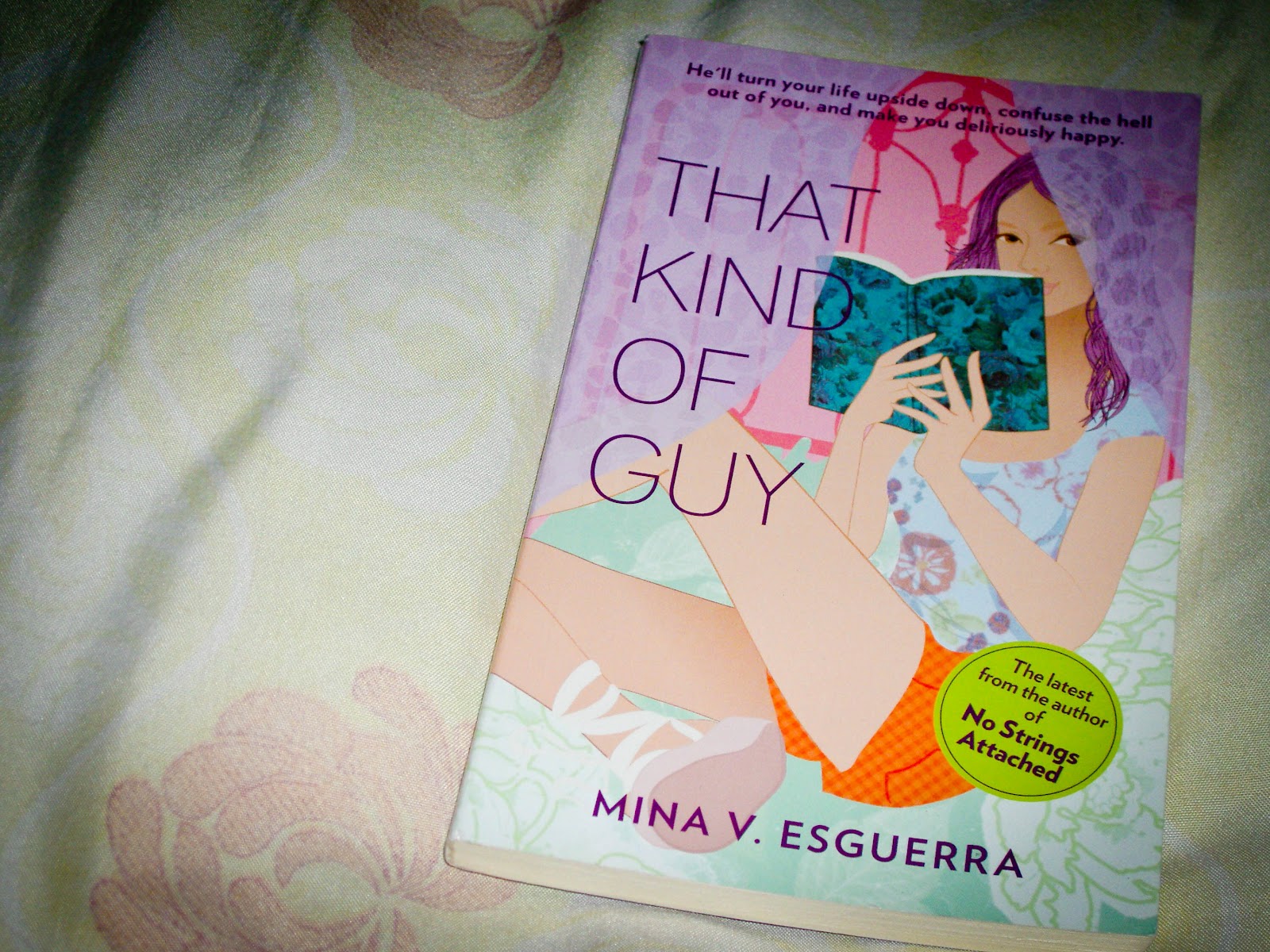
On 'That Kind of Guy'
It is not an uncommon trend on Philippine television shows and in romantic movies where the leading lady, often projected as someone who is plain-looking, will attract a bad boy type. You know the formula; boy is the appealing type with a long list of pretty and insecure girls that are now history, girl is your typical manang who still can't get over her last relationship which ended n years ago. Then the inevitable happened: boy meets girl, girl meets boy. For girl, the meeting was nothing special--she's wary of guys his type, and she's just not impressed. Meanwhile, the seemingly ordinary meeting for girl was actually a pivotal moment for boy, for he is, for the rarest of times, actually in love! We, girls, do not understand however this happened and so we begin to openly criticize the story for being so typical. But deep in our hearts, there is a very small question mark: "what are the chances that this can happen in real life?" Okay, I won't delve deeper into that. You get my point. There is a story that we know how it will end, always. Mina Esguerra's That Kind of Guy is not an exception. It is predictable, story-wise. But, as they say, it is not the destination, but the journey, which really matters. This chick-lit novella was a journey I was willing to take.
One of the reviews is right in saying that it is hard to put down. Primarily because it is a short and easy read. But mainly because it felt like listening to a girl friend I haven't seen for quite some time and there she was telling me her fairy tale all at once.
Wednesday, August 1, 2012
On 'The History of Love'
"Once upon a time there was a boy who loved a girl, and her laughter was a question he wanted to spend his whole life answering."
The story revolves around Leo Gursky, a Holocaust survivor from Poland who came to America for refuge and for the hope to find the only girl he ever loved. Unknown to him, this girl, who left for America before the Germans invaded their place, was pregnant with his baby. She heard about the killings in Poland and, after not receiving replies to her letters, thought he was dead. She gave birth to a son, who grew up to become a famous writer, and married another man. Eventually, Leo found her and realized that he was too late. He stayed in America, learned the trade of being a locksmith, and watched his boy grow up from a distance. He then wrote a book which he titled "Words for Everything."
Friday, May 25, 2012
On 'Me Talk Pretty One Day'
Me Talk Pretty One Day is an unexpected treasure.
I only decided to read it when my sister Joy told me that it's a compilation of autobiographical stories and that the title of the book is also the title of one of the stories about the author's attempts of learning French. Always been a fan of the language, I read the book hoping that it can give me tips. Well, I got none. If anything, I got scared of French teachers. But what I am happy to gain are the fun afternoons I spent smiling, occasionally laughing, by myself while taking a glimpse at David Sedaris' life and the inner workings of his mind. It's either he is just fortunate to be at the right place at the right time--for he finds himself caught in between really interesting situations worth sharing--or he simply has the gift to make a spectacle out of the mundane. Probably both.
I was barely
finished with the first half of the stories when I came up with the idea of
reading the section where acclaims for the author are written. I thought to
myself, "who is this funny guy and how come I have never heard of him
before?" The answer struck me even before I'm through with the
construction of my question: my ignorance is due to the fact that I am
relatively new to the wonderful world of books. But I guess I am knowledgeable
enough to identify Woody Allen, Mark Twain and Oscar Wilde as remarkable
writers. And it so happened that the author David Sedaris is dubbed as our
generation's version of these three and many others. To think that my sister
bought Me Talk Pretty One Day from Booksale at 127 pesos!!! Oh, a fortunate find,
indeed!
Anyway, I got to
keep my emotions in check. Must get down to the business of really talking
about the book.
The stories in the
first half of the book were set in America while the rest, in France. What I
got from reading snippets of Sedaris' life is that he has a crazy--and I mean
the good kind of crazy--family; that he has experienced different kinds of
occupation--from being an assistant to a Colombian miser to being a mover for
an Irish communist, from being an undercompensated writing workshop teacher to
an artist commissioned to perform by a museum; and that he has a knack of
safely avoiding things which makes him uncomfortable, just like the lisp he had
in his childhood and the fact that he can't seem to get the gender assignation
of French vegetables (to fully understand how he did so, just read the book).
But aside from the entertainment derived from his witty storytelling, it can't
be denied that there are underlying messages he wants to get across to his
readers. General truths that are too common that they are normally taken for
granted. His social commentaries are cloaked in such good writing that you
won't notice he is already ranting. He's just got a way to get to you.
Read the book
because you deserve some hearty laughter.
Rating: 4.5/5
Rating: 4.5/5
Tuesday, May 22, 2012
What, for you, is a good book?
Now that I have sort of gotten the hang of
reading books--I have just finished writing a review for my eighth book this
year!--I am wondering what to answer people when they ask if the book was good
or if it's worth reading. What really is there to look for in a book?
One. The content, of
course. Was it worth knowing? Was it value-adding? Did you feel like a smarter
person after you've read that particular book? If yes to all three, then that's
one star!
Two. The writing
style. The technical aspects. For a new member of the bibliophile club (oh how
I love this word!), I think it does matter if I get to know new vocabulary, and
be exposed to a good writing style. In one way or another, it affects how I will
be writing in the days after.
Three. The reading
experience. Reading, based from other more experienced readers, is a journey.
It's supposed to kidnap you from reality and take you to places--your
imagination is the limit! So if a book is capable of bringing you to such
places you'd thought you'll never be and evoke feelings as if you are actually
part of the story, then that is one effective book.
Four. The
appreciation. To the point of having difficulty of only confining it to
yourself that you just have to share it to other people. To the point of
getting so giddy when you talk about it or hear other people talking about it.
To the point of answering "yes" to the question: "will you read
it again?"
Five. The catharsis.
Not all books may be relatable to our life, but all books may be considered
part of us after we have read it. I guess this is the aspect wherein one book
touches us in a deeper level that it's already hard to get it out of our system.
The line that sets apart the forgettable from the unforgettable.
This is not your
critic's guide to rate a book. But it's definitely one way to evaluate. So now,
let’s test my theory.
Twisted
8
|
1
|
1
|
1
|
0.5
|
0.5
|
4.0
|
To
Kill A Mockingbird:
|
1
|
1
|
1
|
1
|
1
|
5.0
|
Good
Omens:
|
1
|
1
|
1
|
1
|
0.5
|
4.5
|
Charlotte's
Web:
|
1
|
1
|
1
|
1
|
1
|
5.0
|
Favorite
Sherlock Holmes Detective Stories
|
1
|
1
|
1
|
0.5
|
0.5
|
4.0
|
The
Mysterious Case of Benedict Society:
|
1
|
1
|
1
|
1
|
0
|
4.0
|
The
Devil Wears Prada
|
1
|
1
|
0.5
|
0.5
|
0
|
3.0
|
Perks
of Being A Wallflower
|
1
|
1
|
0.5
|
0.5
|
0.5
|
3.5
|
On 'Perks of Being A Wallflower'
A coming-of-age
story of a boy which tackles issues like sex, love, family, and friendship,
Perks of Being A Wallflower is a book to which one can relate to in more ways
than one. That feeling of being aware of other people around, wondering how and
what they are feeling at the moment. That feeling of being recognized which
marks the beginning of being conscious of how you want to act in contrary to
what you think others want you to act. That feeling of wanting to be with
friends, how their company makes each second precious, and how their absence
makes life somewhat dull. That feeling of first love and how it doesn't easily
go away. That feeling of always wanting to be reminded that you are
loved--especially by the first people you came to know: your family.
Perks of Being A
Wallflower is the story of a year's happenings in a fifteen-year old boy's
life. It is written in a way that he talks to "a friend" through
letters, giving the reader the sense that they are delving into someone else's
diary. Since Charlie, the protagonist, narrates his story as it happens, the
things he talks about can get too random sometimes. He also deviates from the
topic so often which I find amusing because that's how I am too most of the
time. But what is more fascinating is that those random digressions from the
main topic are actually kind of interesting. Think of the rat experiment.
Subscribe to:
Comments (Atom)